
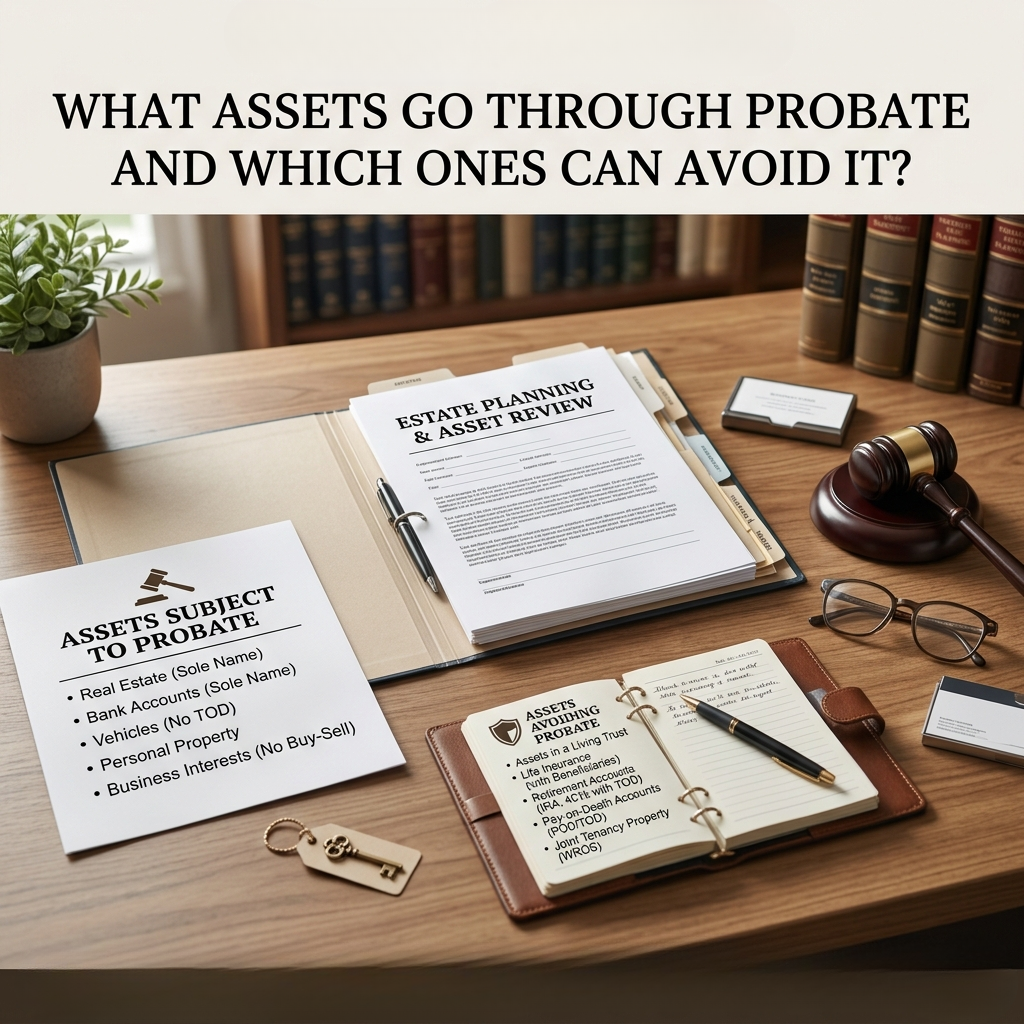
When someone passes away, not every asset becomes part of the probate process. Some assets must go through probate before they can be transferred to heirs, while others may pass directly to beneficiaries or surviving owners under applicable law.
Generally, assets owned solely by the deceased person without an effective beneficiary designation or another valid transfer arrangement are more likely to go through probate. Assets with valid beneficiary designations, certain forms of joint ownership, or proper trust ownership may pass outside probate.
Understanding which assets are subject to probate is an important part of estate planning. The way your property is titled, how your accounts are set up, and whether your estate plan is properly maintained can affect how efficiently your loved ones receive their inheritance.
What Is Probate?
Probate is the legal process used to administer a deceased person’s estate. Depending on state law and the circumstances, the process may involve validating a will, appointing a personal representative, identifying and valuing assets, addressing creditor claims, paying approved expenses, and distributing property to the appropriate beneficiaries or heirs.
Probate serves an important purpose by providing a legal process for administering an estate. However, it can also involve court filings, fees, deadlines, and delays. Probate proceedings may be matters of public record, although the extent of public access varies by jurisdiction and the type of information involved.
For these reasons, many people include probate planning in their broader estate plan. The objective is not necessarily to avoid probate at all costs, but to ensure that assets transfer according to their wishes and that their loved ones have a manageable process to follow.
Which Assets Typically Go Through Probate?
An asset is generally more likely to go through probate when it is owned solely by the deceased person and has no effective beneficiary designation or other valid arrangement that allows it to transfer outside probate.
Common examples include the following.
1. Real Estate Owned Solely in One Person’s Name
A house, condominium, or other real estate titled solely in the deceased person’s name may need to go through probate before ownership can be transferred.
The outcome depends on how the property is titled, whether a valid transfer-on-death deed or similar arrangement is available and was properly established, and the law governing the property.
For example, if a homeowner dies owning a house individually and has not established another valid transfer method, probate may be necessary to transfer the property to the intended heirs.
2. Individual Bank Accounts Without Beneficiary Designations
Checking accounts, savings accounts, and certificates of deposit held solely in the deceased person’s name may become probate assets if they do not have an effective payable-on-death (POD) designation or another applicable transfer arrangement.
A valid POD designation can allow the funds to pass directly to the named beneficiary after the account holder’s death, subject to the financial institution’s procedures and applicable law.
3. Stocks, Bonds, and Brokerage Accounts Without Transfer Instructions
Investment accounts may be subject to probate if they are individually owned and lack an effective transfer-on-death (TOD) registration, beneficiary designation, or other arrangement that permits a non-probate transfer.
Because investment accounts can contain substantial assets, reviewing their ownership and transfer instructions is an important step in estate planning.
4. Vehicles and Personal Property
Vehicles, jewelry, artwork, collectibles, furniture, and other personal belongings may become part of the probate estate if they are owned individually and do not qualify for another transfer method.
Some states offer simplified procedures for transferring certain vehicles or personal property. Whether those procedures apply depends on the property’s value, ownership, and local law.
5. Business Interests Owned Individually
Ownership interests in a privately held business, partnership, or limited liability company may require probate or other legal administration when an owner dies.
However, the governing operating agreement, partnership agreement, buy-sell agreement, and applicable law may establish separate rules for transferring or purchasing the deceased owner’s interest.
Business owners should coordinate their estate plans with their business succession documents to help prevent unnecessary uncertainty for surviving family members and business partners.
Which Assets Can Avoid Probate?
Many assets can pass outside probate when the appropriate ownership arrangements, beneficiary designations, or estate-planning documents are in place.
The following are common examples, although the result depends on the specific asset, the documents involved, and applicable law.
1. Jointly Owned Property With Rights of Survivorship
Certain forms of joint ownership allow an asset to pass automatically to a surviving owner when one owner dies.
For example, real estate held as joint tenants with rights of survivorship may pass to the surviving owner without going through probate for that transfer.
However, not all jointly owned property automatically avoids probate. Tenancy in common, for example, generally does not give the surviving co-owner an automatic right to inherit the deceased owner’s share. The deceased owner’s interest may instead become part of the probate estate.
The precise ownership language on the deed or account documents matters.
2. Retirement Accounts With Valid Beneficiary Designations
Retirement accounts, including many individual retirement accounts (IRAs) and employer-sponsored 401(k) plans, generally transfer according to their beneficiary designations and the plan’s governing rules.
If a valid beneficiary is named, the account may pass directly to that person rather than through probate.
Account owners should review beneficiary designations after major life events, such as marriage, divorce, the birth of a child, or the death of a previously named beneficiary. Certain plans may also have spousal-consent requirements or other restrictions.
3. Life Insurance With Named Beneficiaries
Life insurance proceeds generally pass directly to the named beneficiary when the designation is valid and the policy’s requirements are satisfied.
If no eligible beneficiary is available, the proceeds may instead be payable to the deceased person’s estate, potentially making them subject to probate.
Reviewing life insurance beneficiaries is therefore an important part of maintaining an up-to-date estate plan.
4. Payable-on-Death and Transfer-on-Death Accounts
POD and TOD designations can provide a relatively straightforward way to transfer certain financial assets after death.
- Payable-on-death (POD): Commonly used for bank accounts, allowing funds to pass to a named beneficiary.
- Transfer-on-death (TOD): Commonly used for eligible brokerage accounts and, in some states, certain other property.
These designations can simplify transfers, but they must be properly established and kept current. Availability and rules vary by financial institution, asset type, and jurisdiction.
5. Assets Properly Transferred Into a Revocable Living Trust
A revocable living trust is a common estate-planning tool used to manage assets during life and provide instructions for their distribution after death.
Assets properly transferred into the trust are generally administered under the trust’s terms rather than through probate in the deceased person’s individual estate.
For example, if a homeowner transfers a property into a properly established living trust, the successor trustee may be able to manage or distribute that property under the trust document without a separate probate proceeding for the property.
However, creating a trust alone is not enough. Assets that should be owned by the trust must be transferred into it correctly, and beneficiary designations must be coordinated with the overall plan. Property left outside the trust may still require probate.
6. Certain Assets Passing by Contract or Operation of Law
Some assets transfer according to contractual terms or specific legal rules rather than through a will.
Examples may include certain employee benefits, jointly owned assets with survivorship rights, and accounts with effective beneficiary designations.
The important distinction is that a will does not automatically control every asset a person owns. The ownership structure, beneficiary designation, contract, and applicable law may determine who receives the property.
Probate Assets vs. Non-Probate Assets: What’s the Difference?
The following table summarizes the general distinction.
| Asset type | Typical probate treatment |
|---|---|
| Individually owned real estate without a non-probate transfer arrangement | May require probate |
| Individual bank account without a beneficiary designation | May require probate |
| Vehicle or personal property owned individually | May require probate or qualify for a simplified procedure |
| Jointly owned property with valid survivorship rights | Generally passes to the surviving owner |
| Retirement account with a valid beneficiary | Generally passes to the designated beneficiary |
| Life insurance with a valid beneficiary | Generally passes to the designated beneficiary |
| Eligible POD or TOD account | Generally passes to the named beneficiary |
| Property properly held in a living trust | Generally administered outside probate |
These are general guidelines, not universal rules. State law, the asset’s location, account terms, ownership documents, and the circumstances at death can change the result.
Why Does Probate Planning Matter?
Knowing which assets may go through probate helps you make better decisions about how your estate should be structured and administered.
A coordinated estate plan can help you:
- Reduce avoidable delays. Appropriate transfer arrangements may allow certain assets to reach beneficiaries without waiting for probate of those assets.
- Control how assets are distributed. Wills, trusts, and beneficiary designations each serve different purposes and should work together.
- Protect family privacy where possible. Some non-probate transfers may reduce the amount of property information disclosed through probate proceedings.
- Support loved ones financially. Properly arranged assets may give beneficiaries access to certain funds without waiting for the entire estate to be settled.
- Plan for incapacity and lifetime management. Trusts and other estate-planning documents may help address who can manage assets if you become unable to do so yourself.
Probate avoidance is not the only consideration. Tax consequences, creditor issues, eligibility for certain benefits, family relationships, and the need to provide for minor children or beneficiaries with special circumstances may also influence the right approach.
Common Estate Planning Mistakes That Can Lead to Probate
Even people who have created an estate plan may unintentionally leave assets subject to probate. Watch for these common issues.
1. Creating a trust but never transferring assets into it. A signed trust document generally does not transfer ownership of every asset automatically. Funding the trust is a separate and essential step.
2. Forgetting to update beneficiaries. A former spouse, deceased relative, or outdated designation may create unintended results, subject to the governing documents and law.
3. Assuming joint ownership always avoids probate. The legal form of ownership determines whether a surviving owner automatically receives the deceased owner’s interest.
4. Failing to coordinate the will, trust, and account designations. These arrangements may direct different assets to different people. Conflicting or outdated instructions can complicate administration.
5. Transferring property without considering the consequences. Adding someone to a deed or account can affect control, taxes, creditor exposure, eligibility for benefits, and other legal or financial matters.
Reviewing your estate plan periodically and after significant life changes can help identify these problems before they create complications for your family.
Frequently Asked Questions About Probate and Non-Probate Assets
Does a will prevent assets from going through probate?
No. A will generally explains how probate assets should be distributed and identifies the person you want to administer your estate. It does not, by itself, eliminate probate. Some assets may pass outside probate through valid beneficiary designations, survivorship rights, trusts, or other arrangements.
Do all assets have to go through probate when someone dies?
No. Many assets may pass directly to beneficiaries or surviving owners without probate. Whether an asset requires probate depends on its ownership, beneficiary designations, transfer arrangements, value, and applicable law.
Does a living trust avoid probate?
A properly established and funded living trust can generally help avoid probate for assets held in the trust. However, assets left outside the trust may still require probate unless another valid transfer method applies.
Can a bank account avoid probate?
Yes. An eligible bank account with a valid payable-on-death designation may pass directly to the named beneficiary. Joint ownership or other legally recognized arrangements may also affect how the account transfers.
Is avoiding probate always the best option?
Not necessarily. Probate can provide court oversight, a formal process for addressing claims, and a structured way to resolve disputes. The best approach depends on your assets, family circumstances, goals, and applicable law. Estate planning should focus on achieving the right outcome, not simply avoiding probate at all costs.
How can I find out which of my assets may go through probate?
Start by reviewing property deeds, bank and brokerage account registrations, retirement account beneficiaries, life insurance policies, business agreements, and any existing will or trust. An estate-planning attorney can help determine how these documents work together and identify assets that may need additional planning.
Plan Ahead to Help Simplify the Transfer of Your Assets
Understanding which assets go through probate and which may pass outside it, is an important step toward creating an effective estate plan. The way your property is owned, the beneficiaries you name, and the documents you maintain can all influence what happens after your death.
A carefully coordinated plan may reduce unnecessary delays, clarify your wishes, and make administration easier for your loved ones. It should also account for taxes, creditor concerns, family needs, and the possibility of incapacity.
The best time to review your estate plan is before your family needs to use it. Consider consulting an estate-planning attorney to evaluate your assets, review your beneficiary designations, and determine whether a will, trust, or other planning strategy fits your circumstances.
Remember, this information serves as educational and informational content only and is not a substitute for legal advice. Before making any changes to your estate plan, consult with a lawyer you trust to ensure your decisions align with your individual needs and circumstances. Click the link below to set up a meeting with O’Brien Estate Law, LLC, where we can discuss your specific situation and guide you towards a comprehensive estate plan.