
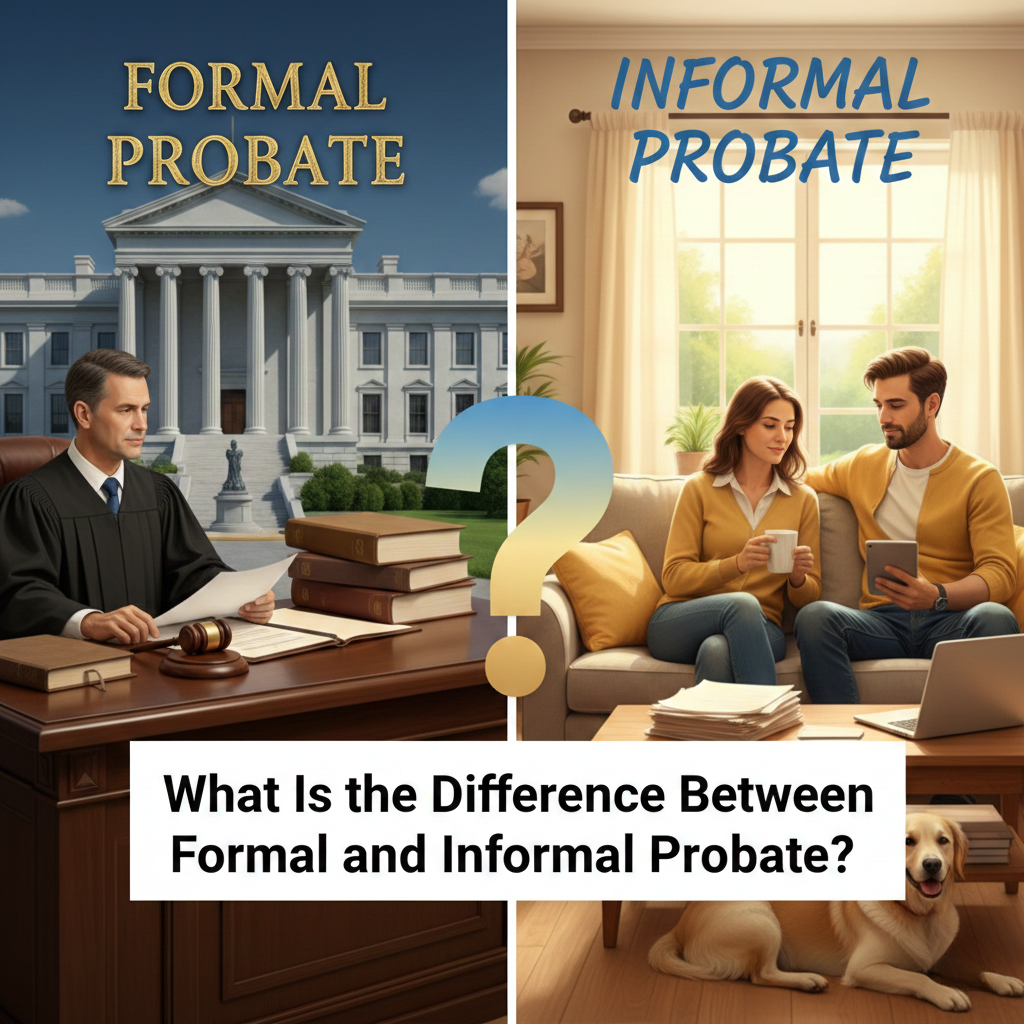
When someone dies, their family may have to navigate a legal process to settle the estate, pay outstanding obligations, and transfer assets to the people entitled to receive them.
That process is generally known as probate.
But probate is not always handled the same way. Depending on the state, the circumstances of the estate, and whether anyone disputes an issue, an estate may proceed through informal probate or formal probate.
What is the difference between formal and informal probate?
Informal probate is generally designed for estates that can be administered without significant court involvement or judicial decisions. Formal probate involves greater court involvement and is generally used when the court needs to resolve a legal issue, dispute, or other complication.
The exact requirements vary by state. Some states use these terms differently, and some have additional probate procedures. For example, Colorado provides separate formal and informal probate procedures, while Arizona courts describe informal probate as appropriate when there is no dispute requiring a judge or commissioner to resolve the matter.
Understanding that distinction is important for anyone serving as a personal representative, executor, beneficiary, or family member involved in settling an estate.
What Is Probate?
Probate is the legal process used to administer certain assets and financial affairs after a person dies.
Depending on the circumstances and state law, probate may involve:
- Determining whether a valid will exists
- Asking the court to appoint a personal representative
- Identifying and gathering probate assets
- Determining the value of estate property
- Notifying creditors and addressing valid debts
- Paying applicable taxes and expenses
- Resolving claims or disputes
- Distributing remaining assets to beneficiaries or heirs
- Closing the estate
Not every asset necessarily has to pass through probate.
For example, certain assets may pass directly to another person through joint ownership, beneficiary designations, payable-on-death arrangements, or a properly funded trust. The specific rules depend on how the asset is owned and the law that applies to the estate.
That is why determining whether probate is necessary, and what type of probate may be appropriate, should begin with understanding how the deceased person’s assets were owned and whether there are unresolved legal issues.
What Is Informal Probate?
Informal probate is generally a simplified probate procedure used when the estate can be administered without the court having to resolve a contested legal issue.
Instead of requiring a judge to make decisions at the outset, the probate registrar or another authorized court official may review the required paperwork and process the estate according to the applicable state procedures.
For example, Colorado’s Judicial Branch explains that opening an estate informally involves less time and paperwork because the court does not review and approve the requested actions in the same manner as a formal proceeding, and there is no court hearing to open the estate.
Arizona’s Maricopa County Superior Court similarly describes informal probate as a process for estates where the will is not being contested and there is no dispute concerning the heirs or beneficiaries that requires judicial resolution.
Informal probate may be appropriate when:
- The will is not being contested.
- The interested parties are not disputing who should inherit.
- The person nominated to serve as personal representative can be appointed without a contested proceeding.
- The estate does not present a legal issue requiring a judge’s determination.
- The required documents can be processed through the state’s informal probate procedure.
One important point is often overlooked: informal probate does not mean there is no court involvement.
There may still be filings, notices, deadlines, creditor procedures, inventories, accounting requirements, and other legal responsibilities. The difference is generally how much judicial involvement is required to administer the estate.
What Is Formal Probate?
Formal probate is a more court-involved proceeding in which a judge or other judicial officer may be required to resolve an issue concerning the estate.
This can become important when the validity of a will, the identity of heirs, the appointment of a personal representative, or another legal question is disputed.
For example, Maricopa County Superior Court explains that formal probate is used when the requirements for informal probate are not satisfied and a judge or commissioner is needed to resolve a dispute.
Depending on the state and circumstances, formal probate may become necessary when:
- Someone challenges the validity of a will.
- There is a dispute regarding who should serve as personal representative.
- Interested parties disagree about the administration of the estate.
- There is a question about who the legal heirs are.
- The court needs to interpret or determine the validity of a testamentary document.
- Another legal issue requires a judicial decision.
Formal probate is not necessarily an indication that something has gone wrong. Sometimes it is simply the appropriate legal procedure for an estate that requires judicial involvement.
The important distinction is that formal probate gives the court a more active role in resolving matters that cannot simply be handled administratively.
Formal Probate vs. Informal Probate: What Is the Difference?
Here is a simplified comparison:
| Informal Probate | Formal Probate |
|---|---|
| Generally involves less judicial involvement | Generally involves greater judicial involvement |
| Often begins through an application or administrative process | Generally involves a petition and court proceeding |
| Typically used when there is no contested issue requiring a judge | Used when judicial determination is needed |
| May not require a hearing to open the estate | May involve hearings or other court proceedings |
| Often involves less procedural complexity | May involve additional procedural requirements |
| The personal representative still has legal duties and responsibilities | The court may issue orders resolving disputed matters |
The terminology and procedures vary by state, so this comparison should not be treated as a universal rule. Colorado, for example, provides distinct forms and procedures for formal and informal probate, while Arizona’s court guidance similarly distinguishes the two based largely on whether judicial resolution is necessary.
Is Informal Probate Always Faster and Less Expensive?
Not necessarily.
Informal probate is often intended to be more streamlined, but the overall time and cost of administering an estate depend on much more than the type of probate proceeding.
An estate can begin informally and still take considerable time to complete.
Why?
Because the personal representative may still need to:
- Locate and value assets
- Determine which assets are subject to probate
- Notify creditors
- Pay valid debts and expenses
- Deal with tax issues
- Sell or transfer property
- Resolve beneficiary questions
- Prepare required inventories or accountings
- Distribute assets
- Complete the necessary closing procedures
In other words, a simpler way to open an estate does not necessarily mean a simple estate.
This is one of the practical distinctions families sometimes discover only after the probate process has already begun.
Can Informal Probate Become Formal Probate?
Yes, depending on the state and the circumstances.
An estate may begin with an informal proceeding, but a later dispute or legal issue can result in a formal proceeding or another form of judicial involvement.
For example, Colorado law provides that a formal proceeding may be initiated even when a will has previously been informally probated.
This is an important practical point for personal representatives and beneficiaries: choosing an informal procedure does not necessarily eliminate the possibility of future court involvement.
If a legitimate dispute arises, the estate may need to address it through the appropriate legal process.
Does Having a Will Avoid Probate?
No. A will does not automatically avoid probate.
A will is an important estate-planning document because it can establish who should receive certain property and who the person wants to nominate as personal representative.
But a will generally works through the probate process when it governs probate assets.
Whether an asset actually needs to go through probate depends largely on how the asset is titled and what transfer mechanism applies after death.
For example, certain assets may pass outside probate through:
- Beneficiary designations
- Joint ownership
- Transfer-on-death or payable-on-death arrangements
- Trust ownership
- Other legally recognized transfer mechanisms
That is why simply having a will is not the same thing as having a complete probate-avoidance strategy.
How Estate Planning Can Simplify Probate?
Good estate planning is not simply about writing a will and putting it in a drawer.
The practical work is often in coordinating the entire estate plan.
That can include reviewing:
- Wills
- Revocable living trusts
- Beneficiary designations
- Retirement accounts
- Life insurance
- Jointly owned property
- Real estate
- Business interests
- Financial accounts
- Powers of attorney
- Health care documents
The goal is to make sure the documents and asset ownership work together rather than unintentionally pulling the estate in different directions.
For example, a person may have a carefully drafted will but leave a beneficiary designation outdated after a divorce, remarriage, or the death of a beneficiary. The will may not control that account simply because it contains different instructions.
Estate planning is ultimately about coordination.
The better the plan reflects how assets are actually owned, the easier it may be for the family and personal representative to understand what needs to happen after death.
What Should You Do If You Are Unsure Which Probate Process Applies?
If you are serving as a personal representative or helping administer a loved one’s estate, do not assume that informal probate is automatically the right choice simply because the family gets along.
Likewise, formal probate is not necessarily a sign that the estate is unusually large or that someone has done something wrong.
The appropriate procedure depends on the state’s probate laws, the nature of the assets, the estate-planning documents, and whether any legal issues require court determination.
Before filing probate documents, it is worth determining:
- Does the estate actually require probate?
- Which assets are probate assets?
- Is there a valid will?
- Who has priority to serve as personal representative?
- Are there potential disputes among beneficiaries or heirs?
- Are there creditor, tax, or title issues that need attention?
- Does state law permit informal probate for this particular situation?
These questions can prevent a family from choosing a procedure based on an assumption that does not fit the estate.
Frequently Asked Questions About Formal and Informal Probate
1. What is the difference between formal and informal probate?
Informal probate generally involves less judicial involvement and is typically used when an estate can be administered without a contested legal issue. Formal probate involves greater court involvement when a judge or other judicial officer needs to resolve an issue.
2. Is informal probate faster than formal probate?
It can be, because informal probate generally involves fewer court proceedings, but the overall timeline depends on the estate, state law, assets, debts, creditor requirements, and whether complications arise.
3. Does every estate need probate?
No. Some assets may pass outside probate through beneficiary designations, joint ownership, trusts, or other legally recognized transfer mechanisms.
4. Does having a will avoid probate?
No. A will generally directs the distribution of probate assets through the probate process rather than automatically avoiding probate.
5. Can an informal probate become formal?
Depending on state law, a matter that begins informally may later require formal proceedings if a dispute or legal issue arises.
6. Is formal probate only for large estates?
No. The need for formal probate generally depends on the legal and factual circumstances of the estate, not simply its size.
Conclusion
The difference between formal and informal probate generally comes down to the level of court involvement and whether the estate requires a judge or other judicial officer to resolve a legal issue.
Informal probate can provide a more streamlined path when an estate is uncontested and the applicable state law permits the matter to be handled administratively. Formal probate provides a structured judicial process when questions or disputes require court resolution.
But probate is only one part of the larger estate-planning picture.
The real work in many estates happens before anyone walks into a courtroom, or files the first probate document. Properly coordinated wills, trusts, beneficiary designations, property ownership, and other estate-planning documents can help give your family clearer instructions and reduce uncertainty when those instructions eventually need to be carried out.
If you are planning your estate or serving as a personal representative, understanding how your state’s probate process works can help you avoid unnecessary complications and make more informed decisions. An experienced estate planning attorney can review your circumstances and explain which options may apply to your particular situation.
Remember, this information serves as educational and informational content only and is not a substitute for legal advice. Before making any changes to your estate plan, consult with a lawyer you trust to ensure your decisions align with your individual needs and circumstances. Click the link below to set up a meeting with O’Brien Estate Law, LLC, where we can discuss your specific situation and guide you towards a comprehensive estate plan.